
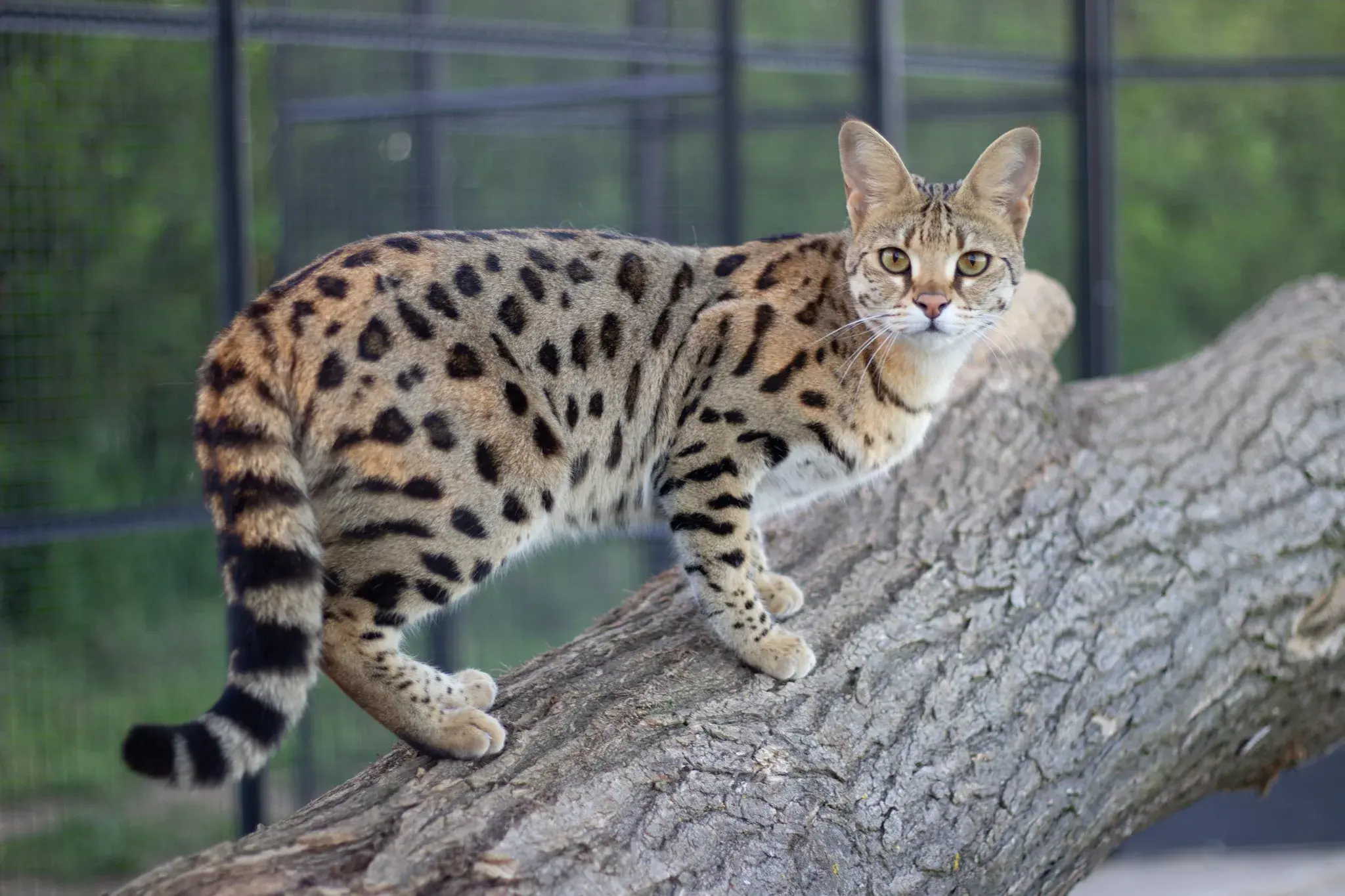
The Savannah, the elegance of a wild feline
Our cattery specialises in the high-generation Savannah (F1-F2), among the rarest in the world.
An exceptional feline, close to the Serval
The Savannah is born from a cross between an African Serval and a domestic cat. At The Wild Rendez Vous, we specialise in high-generation Savannahs (F1-F2), among the rarest in the world.
The Savannah F2 is the most advanced generation — that is, the closest to the Serval — that you can acquire in France. Bred directly from a cross between a Savannah F1 and a Savannah F5, it keeps a high percentage of serval blood, which gives it an impressive physique.
A one-of-a-kind temperament and look
A spectacular appearance
Large in size, with long legs, tall ears, a slender body and a spotted coat much like the serval's.
Remarkable intelligence
Able to learn tricks, walk on a lead and form a very strong bond with its human, much like a dog.
Energy and drive
An athletic feline that needs space and interaction to fully thrive, with a strong hunting instinct.
Understanding the F1 to F5 generations
With the Savannah, the letter "F" is followed by a number showing the generational distance from the serval ancestor: the lower the number, the closer the cat is to the wild feline.
- F1
- The first cross, with an African Serval as a direct parent. This is the generation closest to the wild cat: rare and spectacular.
- F2
- The result of crossing a Savannah F1 with a Savannah F5. It keeps a high percentage of serval blood — the most advanced generation you can acquire in France.
- F3
- The third generation from the serval. The temperament settles down little by little while keeping the breed's signature wild look.
- F4
- The fourth generation. Still considered a hybrid, it remains subject to regulation in France.
- F5
- From the fifth generation onwards, the Savannah is considered a domestic cat: no special permit is required to keep one.
The Savannah's specific needs
The high-generation Savannah needs particular care in order to thrive.
A BARF diet
The high-generation Savannah is fed exclusively on BARF — a raw-meat diet. A natural diet that meets its physiological needs.
A secure space
A highly agile, curious and energetic cat, the Savannah needs a secure, code-compliant indoor and outdoor environment. A high-generation Savannah does not roam freely outdoors.
Human interaction
Deeply attached to its human, it enjoys regular interaction and learning: it can walk on a lead and learn tricks.
An available owner
Its energy and strong hunting instinct call for presence, space and interaction. This is a bonded feline that needs an available household in order to thrive.
Regulations on keeping a Savannah in France
From when is a Savannah considered a domestic cat?
From generation F5 onwards, the Savannah is considered a domestic cat: no special permit is required to keep one.
Do you need a permit for a Savannah F1 to F4?
Yes. Hybrid Savannahs from F1 to F4 are classed as non-domestic animals. Since 2018, keeping them requires a specific permit from the DDETSCPP of your department. They are also listed in Appendix II of the Washington Convention (CITES): any import or export outside the European Union requires a CITES permit issued by the DREAL.
Does The Wild Rendez Vous guide you through these steps?
We hold the capacitaire félin non domestique (non-domestic feline certificate) and we guide you through these steps, for an adoption that is both smooth and fully compliant.
Our Savannah breeding
A responsible, human-scale cattery in Seine-et-Marne, near Paris. We put quality before quantity, with a limited number of breeding cats.
Carefully selected lines
We work with internationally recognised breeders to source Savannahs of exceptional quality.
A suitable environment
Our cats live in secure indoor and outdoor spaces, designed for their wellbeing.
Advanced socialisation
Our kittens are handled from birth and used to everyday sounds, to children and to other animals.
Rigorous veterinary care
Systematic health testing, vaccination, identification and a certificate of good health before any adoption.